By Paul Guernsey Editor-in-Chief
Provided courtesy of Fly Rod & Reel magazine
Tony Hayes spotted the first huge rainbow only minutes after the helicopter had dropped us off and then gone clattering away again. I was still taking in the scenery, admiring the beauty of the remote jade-color river and its arid, nearly treeless valley, which reminded me a great deal of the American Southwest.
“That’s a bloody big fish,” announced Tony, who as long-time owner of Tongariro Lodge, near Lake Taupo on the country’s North Island, has seen his share of bloody big fish. He pointed out what to me was a barely discernable shadow hovering next to a midstream boulder, then he picked up my flyless leader and tied on a big grasshopper! …
Tony’s fly choice was nowhere near as surprising to me as it might have been just a few days before. My first fishing trip to New Zealand was by then more than a week old, and I had already discovered that a lot of things I’d heard and read back home about angling there bordered on mythology. I’d been told, for instance, that I could expect to fish most of the time with nothing other than somber-looking nymphs – and that after a couple of imperfect casts to any particular fish, I might as well give up hope of ever catching it.
Perfect casts are rare with me, so I was relieved to find that, on the whole, Kiwi fish were more forgiving than I had been lead to believe. I was also delighted to learn that, not only would they often take dry flies, but that a four- or five-pound or larger rainbow would often move a good distance to eat one.
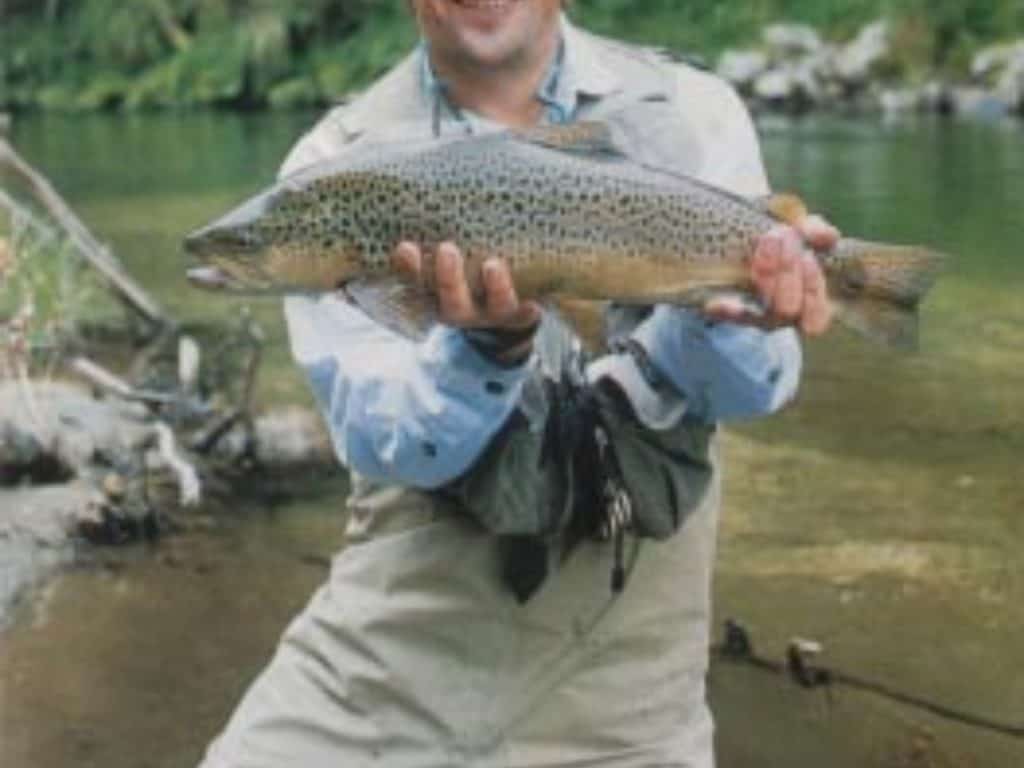
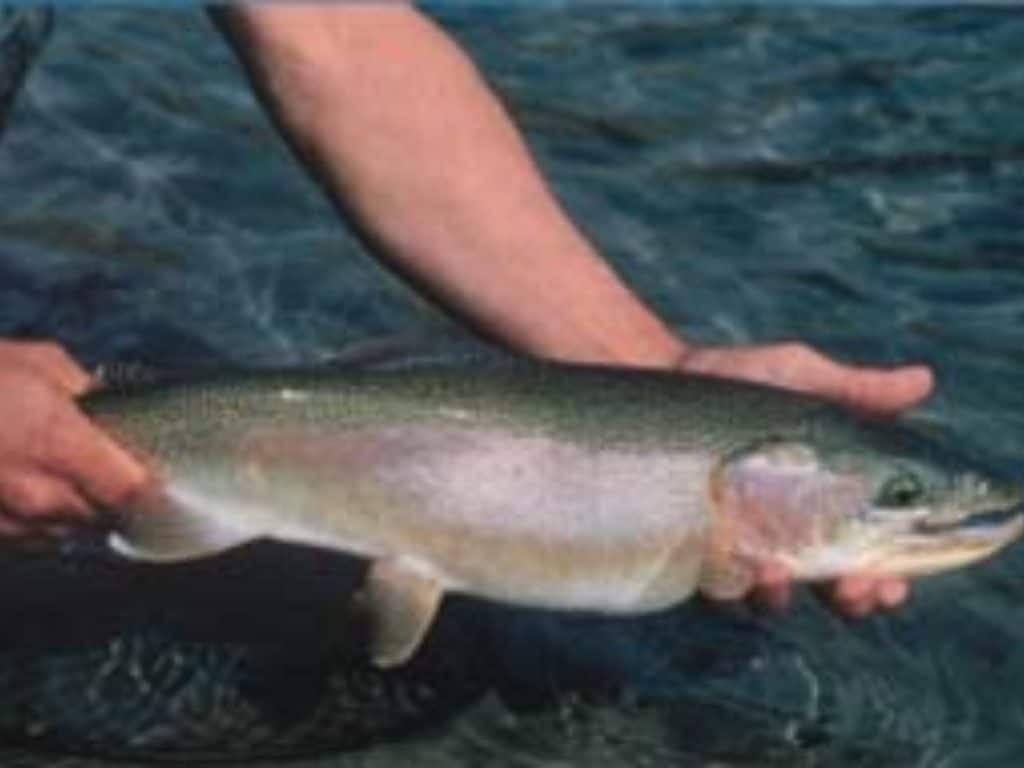
This big rainbow was caught on the North Island just as you might expect. But the northern rivers also produce some fine browns like the one below. In fact, sometimes a trout would travel several feet to tackle a huge dry fly just like the hopper Tony had tied on for me. On my second cast to the boulder, the fish rose through a couple of feet of water to hit that big bug. I lifted the rod, but hooked only water.
“Oh!” exclaimed Tony. “He took it and spit it out. You really have to set the hook hard on these big fish, their mouths are very tough.”
This would have been the right thing to say to almost any other trout fisher. But to a fairly excitable angler who spends a lot of time fishing for striped bass…. Well, let’s just say it was a piece of advice we would both come to regret that day.
Ten minutes later we were looking down from a rock ledge into a deep green pool inhabited by a single, monstrous, slow cruising rainbow.
“Ohhhh, that’s a bloody big fish,” Tony said as we hugged the ledge to keep ourselves hidden. One thing I had heard about New Zealand angling was entirely true: The trout themselves are exaggerated. In other words, a bloody big fish there is bloody bigger than a bloody big one just about anywhere else.
“I’d say that one is better than 10 pounds,” Tony whispered He rigged up a 6-weight rod with a heavy nymph and a sheep’s wool indicator about four feet above it. From a sitting position I pitched the fly into the fish’s path three or four times before he finally opened his mouth and casually inhaled it.
I set the hook, stood to get all the loose line back on the reel – and then made a terrible mistake. While the fish was down deep in the water, shaking his head, I touched the handle of the reel, and that was all the extra tension it took to pop the fluorocarbon tippet.
After that, my nerves came unraveled. I had a couple of good fish take while I was blind-fishing with nymphs in a short stretch of fast water – but broke them both off with my striped-bass hook set.
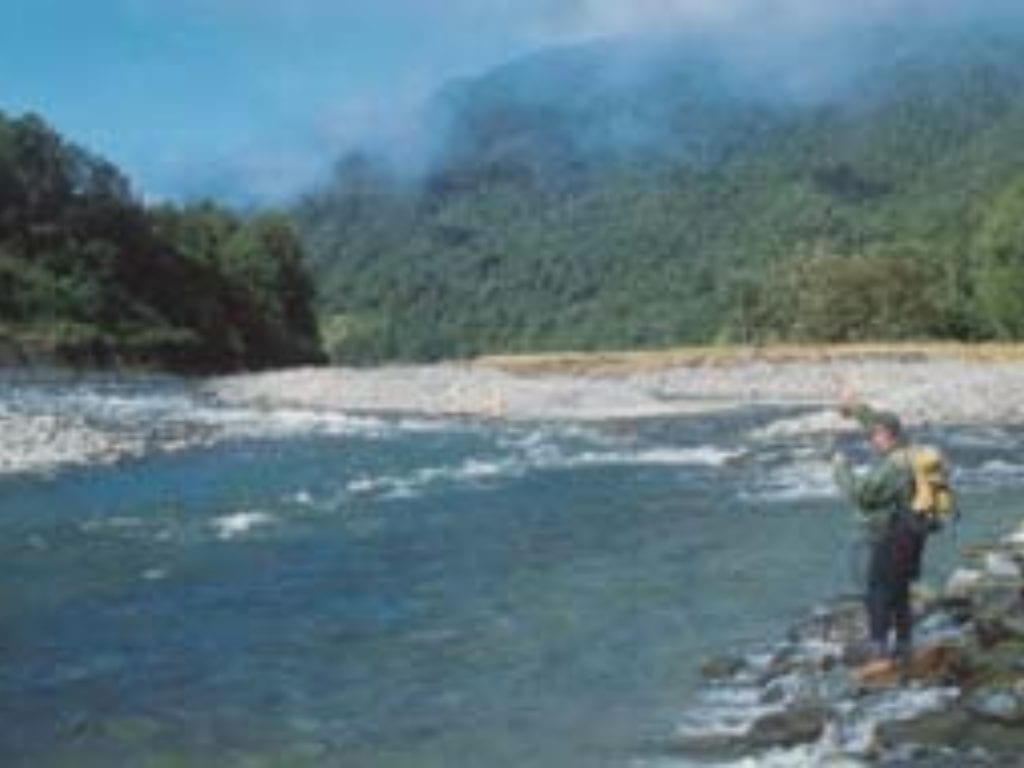
Then Tony guided me to a couple of “bloody big browns” – he said at least one of them was another 10 pounder along the bushy edge of a skinny riffle. I got both of them to take, then each time set the hook so hard I never even felt them at the end of my leader.
A lunch break allowed me to pull myself together, and shortly thereafter I dropped a grasshopper in the slow water beside a lushly green, tropical-looking bank and had a rainbow sloooooowly come up to eat it. As Tony released the fish, he told me it weighed about five and a half pounds. Most definitely not a bloody big one – at least not by New Zealand standards.
Of course, now that my marbles were halfway back in the bag, not only did we find no more double-digit fish as we moved upriver, but trout of any size became scarce. Finally, as I fished a comer pool darkened by late-afternoon shadows, we heard the helicopter droning up the valley as it searched for us.
Without a lot of hope in my heart, I was tossing a large, gaudy dry fly called a Christmas Tree. At one point, as the fly hung directly downriver, making a huge wake on the surface, I looked over my shoulder to say something to Tony and it was then that a big rainbow came up and almost jerked the rod out of my hand.
I beached that fish just as the helicopter was setting down on a nearby gravel bar. It was nearly eight pounds; it would turn out to be the largest fish of my New Zealand trip. And it was a complete accident.

I spent two weeks between the middle and the end of March — late summer/early fall Down Under — traveling among four of New Zealand’s finest and most well-established fly-fishing lodges. I visited Lake Rotorua Lodge and Cedar Lodge on the South Island, and Tongariro Lodge and Poronui Ranch on the North Island, fishing a couple of days at each place.
All four lodges have been in operation for at least 20 years and, while each offers something different in terms of scenery, fishing and style of hospitality, I found them all to be enchanting places, with superb food and first-class accommodations.
More important, however, at each lodge the guides and the fish themselves schooled me on a different facet of New Zealand fly-fishing, and frequently disabused me of a myth or two about angling in the islands. So, while I can claim only a brief acquaintance with Kiwi angling, I feel confident enough to say that, if you’ve never fished there,a lot of the things you’ve probably heard about it may not be true – or at least, they’re only true some of the time, or no more than partially true at any time.
For example…
You may have read that the angling is so tough that, unless you’re an expert caster, you’d be wasting your time to go there. Of course, it always helps to cast well and, since New Zealand’s ultra-clear water often necessitates careful, quiet South Island guide Scott Murray blind-fishes a lot – and it works approaches and difficult-to-cast leaders just as well there as it does anywhere else. of 12 to 16 feet, the more skill and experience you bring with you, the more successful you’ll be. And yet, at Lake Rotorua Lodge on the South Island, I met an entire family of fly-fishing neophytes from the states — an older couple and their son and daughter-in-law, none of whom had ever fly-fished before — who caught a few browns from three to six pounds every day they were there.
And then there’s this one …
The fish are so few and far between that you’ll walk half a morning just to find one. – and then you’ll spook it with the first bad cast. If you’re lucky as well as skillful, you might catch one fish during your angling day — although that fish is apt to be quite large. Maybe that’s the way it is in some places at some times of the year. But on just about every stream I fished, and on both islands, if I “stiffened” a fish with a bad cast — and I did that pretty often — the guide would find another one for me 50 or 100 yards upriver.
In addition, huge Lake Taupo, on the North Island, boasts spawning runs of both rainbows and browns that swarm into its tributaries – most notably, the world-famous Tongariro River. While I was staying at Tony Hayes’ Tongariro Lodge, at least one pair of anglers fishing out of that establishment caught around 20 lake-run fish in a single day.
It’s all sight fishing. It’s a lot of sight fishing, which is the way I like it. Unlike a lot of sight fishing in the US, however, in New Zealand you’re usually casting to the sighted fish itself, rather than to a surface-breaking fin or snout or riseform. Just as you’ve no doubt heard, the water there typically is clear as glass, and big fish often hang out in surprisingly shallow, exposed areas because there are no ospreys, eagles or other winged predators to make them feel vulnerable.
But on some of my New Zealand fishing days, half or more of my trout were the products of blind-fishing with nymphs in water too deep and fast to spot them in.
It’s almost all nymph fishing. Dry fly fishing is a rarity. I took quite a few fish on nymphs, including the largest brown – a seven pounder – of my life. But I’ve already mentioned how the biggest fish of my trip fell to a large dry fly – as did a lot of other Kiwi trout. In fact, one day when I was fishing a small creek out of Poronui Ranch on the North Island, I caught rainbow after rainbow in the four- to five-pound range on a size 8 Royal Wulff.
Of course, the fish will take smaller, more imitative dry flies as well. As Lake Rotorua Lodge guide Scott Murray explained it, New Zealand has plenty of aquatic insects — it just doesn’t have the big, consolidated hatches of them that occur on a lot of US rivers. While you might sometimes find several fish rising to duns or emergers in a particular stretch of water, it’s likely each one is feeding on something slightly different. The key is to keep changing flies until you find one that works.
In fact, Scott changed my fly seven or eight times before I finally hooked one six-pound brown he’d found for me. 1 should add that I made at least a half-dozen casts with each fly — not all of them good ones — and that brown kept right on feeding. Which leads me to …
The fish spook with incredible ease, and will never move more than an inch or two to take a fly. It’s true that a lot of the browns did not want to move very far to eat. On the other hand, they usually gave me at least a few chances to put one in the strike zone before they either swam away or — more frequently — decided to settle to the gravel and imitate a stone.
And the rainbows often were surprisingly eager takers. Fishing the beautiful, braided mountain-valley rivers to which the South Island’s Cedar Lodge flies its clients, I caught rainbows that would move four to eight feet through still water to grab a grasshopper imitation.
And this reminds me that prior to my trip I’d heard …
The South Island has all the brown trout. The North Island has nothing but rainbows. Well, browns do predominate on the rugged South Island, while the North Island has much more of a rainbow fishery. But that seven-pound brown I mentioned earlier? 1 caught it on the North Island, fishing with guide Mark Aspinall out of Poronui Ranch.
And during the two days I fished from Cedar Lodge, on the South Island, I caught nothing but rainbows — although while I was there another client caught a seven-pound brown practically out the back door of the lodge itself.
New Zealand fish will spook if you use anything other than a dull-color line. The jury is still out on this one. One guide thought my light gray Scientific Anglers AST line was still too showy, and he insisted on dyeing it dark green the night before we went fishing. Yet, the owner of a different lodge encouraged his clients to use their bright orange and yellow floating lines, saying that fine color made absolutely no difference to the fish.
You have to fish out of a helicopter to have great fishing in New Zealand. A helicopter definitely helps. just as in the US, you have an advantage when you can get someplace where other anglers are unable to easily walk or drive. In fact, the advantage is greatly multiplied in New Zealand, where on average there are many fewer fish per river mile. My guides told me time and again that once an even moderately skillful angler works a section of river there, the relatively sparse population of trout he’s either caught or cast to will often be reluctant to look at flies for a week or more.
If you stay at Cedar Lodge, you’ll probably fly to your fishing every day the weather permits it, because owner Dick Fraser owns – and flies – his own machines, and the flyouts are included in the price of your stay. At other places, even though you’ll pay extra for a chopper fly-out, I’d recommend flying to a remote river at least once during your New Zealand stay; it’s worth it just for the experience.
Private water also confers an advantage in New Zealand just as it does anywhere else, and almost all the lodges I visited have access to some of that as well. Poronui Ranch, in particular, has so much private water under contract that, even if you don’t spring for a helicopter fly-out or two, they can almost guarantee to put you on river beat that hasn’t seen an angler in 10 or more days. I caught my big Poronui brown after a brief ride in Mark Aspinall’s pickup truck, followed by a short – but steep – hike into a jungly canyon.
But during my trip I had several great angling days on rivers that anyone could fish if they wanted, just as I had a couple of helicopter days that resulted in relatively few fish sighted, let alone caught.
At Lake Rotorua Lodge, in fact, I fished nothing but drive-to rivers on open-to-anyone ranchland, and I was delighted with the experience. I owe my success there to the diligent homework Scott Murray would do the night before each of our fishing days. Scott would call the landowners and ask if anyone had fished the local river in the last week or so. If the answer was yes, he’d call a different rancher about a different piece of water.
And this suggests the topic of …
Guides. You need one in New Zealand. They’re extremely helpful, or course, just as they are on any unfamiliar water. A good Kiwi guide not only spots trout for you – something you’ll have trouble doing at first – and helps you select a fly, but he or she usually also finds a good vantage point from which to observe both your fish and your fly, then tries to coach you into making a cast that has some hope of working.
If you have a lot of time to spend in New Zealand – a month or more, say – and a high frustration level, you might enjoy just knocking around a bit by yourself, fishing here and there, taking in some of the world’s most awesome scenery and getting acquainted with some of the world’s friendliest people.
For my part, though, I’m not laidback enough for this kind of casual, hit-or-miss fishing. If I were to travel around New Zealand again, I’d want a guide for at least a day in each area I was fishing. And if on my next visit I’m restricted to no more than a couple of weeks in the country, I’d prefer to spend most of my time at a lodge or two in order to fish on good water every possible minute without having to worry about such creature concerns as where to stay, and what and when to cat. Maybe that sounds obsessive, but that’s me. New Zealand may well have the best trout fishing in the world, and if I’m ever lucky enough to go back, that’s how I want to spend all my time.
Travelling to New Zealand is an ordeal. Actually, I traveled from the East Coast to Los Angeles, then all the way to the South Island, and it wasn’t too bad. Air New Zealand has nonstop flights that leave Los Angeles in the evening and arrive in Auckland early the next morning. I consider this to be just about the perfect schedule for a traveler hoping to dodge jet lag.
After a good meal and a couple of glasses of wine on the plane, I slept a solid seven hours and woke up feeling refreshed. In Auckland, I caught my domestic flight for the South Island, drove to Rotorua, and still felt good enough to put in a half-day’s fishing.
Paul Guernsey is Fly Rod & Reel’s new Editor-in-Chief.